The Underwater Forest
From California to Japan to Tasmania to Norway, the kelp forests that built the edge of the sea are disappearing, and the people who depend on them are watching it happen in real time.
Thirty feet below the surface, in the right waters, along the right coast, you enter another world. The light changes first, filtered through canopy a hundred feet tall, arriving in long cathedral shafts of green and gold. You hear almost nothing. What moves above you is not wind but current, and what sways in it is not branches but fronds, some of them as thick as rope, growing from the seafloor to the surface of the sea. Around you is a vertical world of astonishing complexity, built entirely from algae and saltwater and time.
This is a kelp forest. Or rather, this is what one was.
In the decades since human-caused warming began to alter the temperature and chemistry of the ocean, kelp forests on nearly every continent have contracted, fragmented, or disappeared. What were once among the most productive ecosystems on earth, coastal corridors of life rivaling tropical rainforests in their species density and ecological reach, have become, in many places, barren. Pale rock. Carpets of purple spines. Silence where there was once sound, and current, and life.
These are the stories of people watching it happen.
What Was There
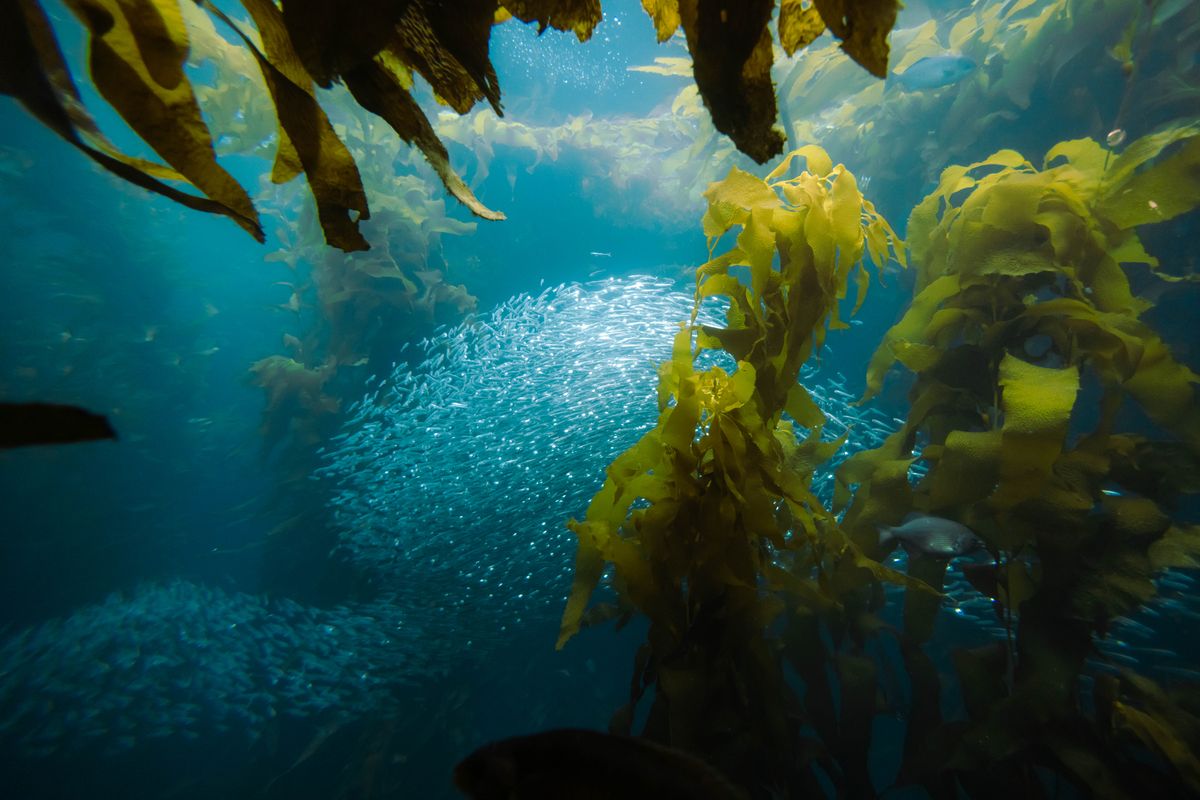
Giant kelp, Macrocystis pyrifera, is the largest marine alga on earth. Given cold, nutrient-rich water, a rocky seafloor, and enough light, it grows at a rate of up to 18 inches per day. A single frond can extend 150 feet from its anchor point on the seafloor to the sunlit surface above. In a forest of thousands of these fronds, swaying together in current, the result is an ecosystem of staggering complexity and generosity.
At least 800 species of fish, invertebrate, and marine mammal depend on kelp forests for food, shelter, spawning grounds, or nursery habitat. Sea otters wrap themselves in kelp to sleep without drifting. Young rockfish hide in the canopy. Lingcod patrol the water column. Abalone scrape holdfasts for algae. Scientists have called kelp forests the sequoias of the sea, not just for their scale, but for the sheer magnitude of life they sustain. The estimated global value of kelp forest ecosystem services, carbon sequestration, fisheries support, coastal protection, nutrient cycling, exceeds $500 billion per year. These forests fringe approximately 25% of the world's coastlines. And they are disappearing.
"Kelp are the forgotten forests of our ocean. Depleted by as much as 95 percent in some regions, they need our help to recover." (National Geographic)
Fort Bragg, Northern California
Grant Downie is a commercial diver who worked the waters off the Mendocino Coast for most of his adult life, an industry built, in ways both visible and invisible, on the health of the bull kelp that once blanketed these shores from the surface to the deep. He was in his early thirties when the change came.
In 2013, a pathogen swept through the tidepools and shallows of the Pacific Coast of North America and killed, within two years, an estimated 5.75 billion sunflower sea stars, the primary predator of the purple sea urchin. With nothing to check them, urchin populations exploded. Then, in 2014, a mass of anomalously warm water that oceanographers named the Blob settled across the North Pacific and held sea surface temperatures at 4°F above normal for nearly three years. Cold, nutrient-rich water stopped upwelling from the deep. Kelp, which requires cold water to photosynthesize and grow, began to die.
Into that dying forest came the urchins. Where Downie had once moved through cathedral structure, fronds rising overhead, fish schooling through shafts of filtered light, the floor became a carpet of purple spines. Densities in some zones reached 70 sea urchins per square meter on rock that had previously been bare. The urchins entered what biologists call a zombie state: no longer actively grazing, simply waiting, capable of surviving for years on the biofilm of bare rock, consuming any kelp spore that attempted to reestablish.
As documented by National Geographic, by 2016 more than 90% of the bull kelp that once lined a 200-mile stretch of Northern California coast, from Mendocino to Sonoma, had disappeared. The ocean floor, where a forest had stood, was bare. It was quiet in the way that only a place that used to be full of sound can be quiet.

A healthy kelp forest canopy. Giant kelp grows up to 18 inches per day and can reach 150 feet from seafloor to surface, creating an ecosystem that supports over 800 marine species.
Osatsu Village, Mie Prefecture, Japan
Before the sun has fully risen over the Kii Peninsula, Ayami Nakata is already at the dock. She is 44 years old, a mother of five, and she has been diving these waters for seven years, a newcomer, by local measure, to a tradition 3,000 years old. She changes into her wetsuit, collects her facemask and chisel, boards her husband's small fishing boat, and motors a few hundred meters offshore. Then she enters the water.
For an hour and a half, she takes minute-long plunges into cold that numbs her fingers. Free-diving to the rocky seafloor, 20 feet, 30 feet, now sometimes 50, she searches for abalone, sea cucumbers, turban shells. Between each dive, she surfaces and performs isobue, the sea whistle: slowly, carefully inhaling as deeply as she can, filling her lungs, filling the morning air with a sound that has been made at the edge of this sea for longer than written history. "I have to be very mechanical," she says. "But all the stress goes away."
Nakata is an ama, 海女, women of the ocean. The ama divers of Japan's Mie Prefecture have worked these coastal waters since before written history, harvesting shellfish and seaweed by hand from the seafloor in one of the most ecologically sustainable fishing traditions ever developed. No nets. No tanks. No bycatch. Their footprint on the seabed is surgical, the prefectural government enforces strict catch limits, tool restrictions, and seasonal windows to prevent overharvesting. For generations, this balance held: a millennia-old agreement between a community and the sea it depended on.
Before each diving day, the women gather in their amagoya, traditional dockside huts, and recite a prayer in unison: "I ask for plentiful abalone, sea snails, and sea urchins. I beg you. Please protect us from accidents, the sea, sharks, and other disasters." A practical prayer. An honest one. Made by people who understand that the ocean gives and takes according to forces beyond human control, and who built their entire culture around living carefully within that understanding. The problem is that the ocean has changed faster than the prayer has words for.
Japan's coastal waters are experiencing what the people who live on them call isoyake: seaweed denudation. The kelp beds and seagrass meadows that once carpeted the nearshore shallows, providing habitat, food, and spawning grounds for the entire coastal ecosystem, are disappearing. Most ama divers attribute it directly to climate change and the warming of the Kuroshio Current along Japan's Pacific coast. The water feels warmer on their skin than it did a decade ago. Academic research confirms the thermal trend, and adds: invasive sea urchins, chemical runoff from land, and adjacent commercial overharvesting in unprotected zones.
The consequences are visible in the catch. Senior divers, some still active in their eighties and nineties, remember when they accidentally stepped on abalone in shallow water. They were everywhere. Today, those same grounds require a descent of 50 feet to find the same shells, and the divers come up with far less. The three abalone species the ama harvest are now officially listed as endangered by the International Union for the Conservation of Nature.
"The catch is less and less. The temperature changed, the current changed. We are so angry, so angry." (Kiku Kaito, ama diver, Toba, Japan)
Kiku Kaito runs the Kaito Yumin Club ecotourism agency in Toba. She dives still, a few times a year, more symbol than livelihood. She supports the prefecture's hatchery programs, which raise juvenile abalone and kelp in tanks and release them into coastal waters. She believes the ama can fight. But the numbers tell a harder story: the community has fallen from nearly 10,000 active divers in the postwar years to fewer than 1,200 today. Their average age is over 60. In 2015, Toba City opened a formal recruitment campaign for ama apprentices. Two women applied. One stayed.
Tasmania, Australia
Off the eastern coast of Tasmania, the Southern Ocean flows in a current warming faster than almost any comparable body of water on the planet. Scientists classify Tasmania's east coast as a global ocean heating hotspot. In less than one human lifetime, the length of a career, a long marriage, the span between a parent's first dive and a child's first memory, 95% of the giant kelp forests that once draped this coast have vanished.
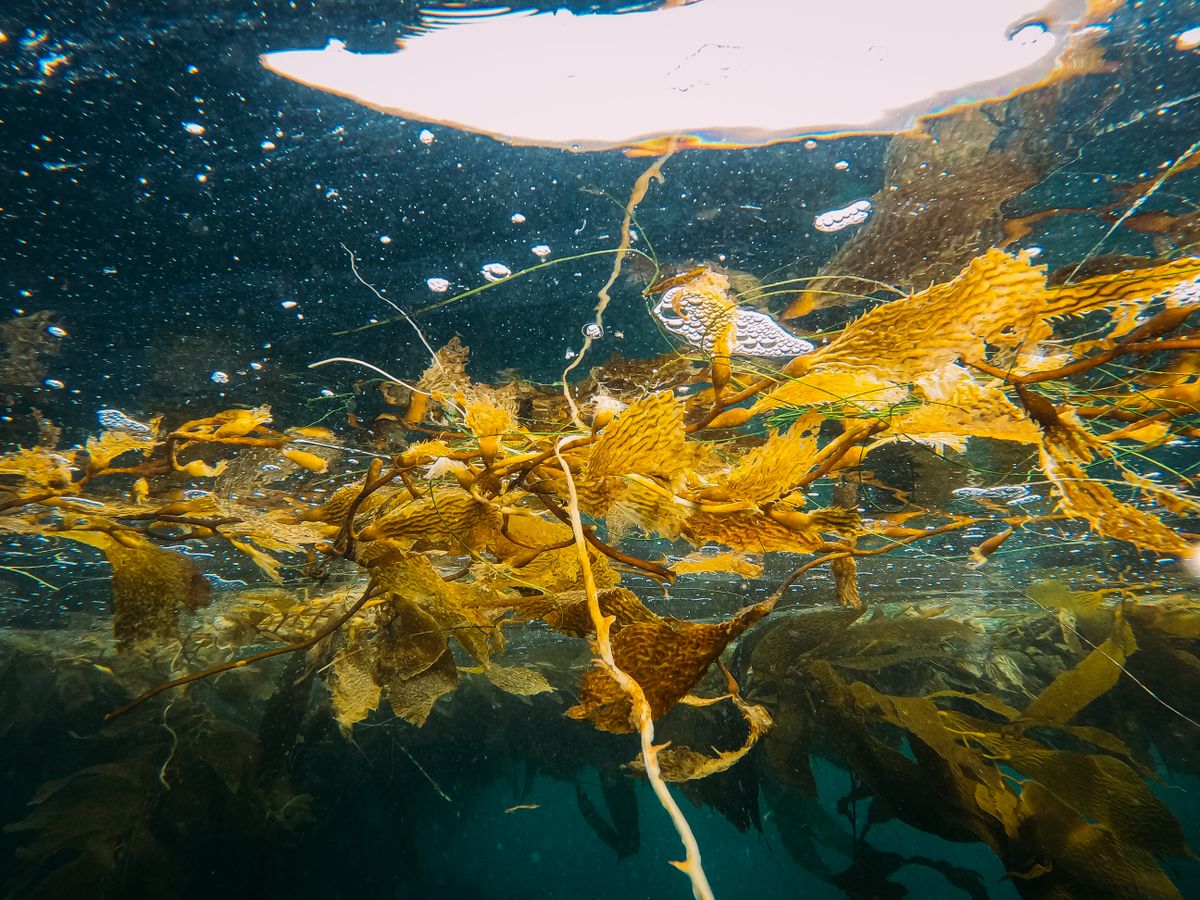
The species at the center of this loss is Macrocystis pyrifera, the same giant kelp that built forests along the coasts of California, Patagonia, and the fjords of South America. It cannot photosynthesize efficiently above a certain temperature. As the East Australian Current pushed progressively farther south over decades, bringing warmer, nutrient-poor water with it, the kelp weakened and thinned. Then the long-spined sea urchin, a subtropical species, historically rare on the Tasmanian east coast, followed the warm water in. With no predators to limit their numbers, the urchins grazed down whatever attempted to regrow. Productive reef became bare rubble. Where a forest once grew to the surface and filtered afternoon light, there is now rock, and spine, and absence.
Researchers at the Institute for Marine and Antarctic Studies are cultivating heat-tolerant kelp strains, selecting individuals that survived the warming, breeding for resilience, planting in warmer water to test what holds. It is slow, generation-by-generation work with no guaranteed outcome. But it is the work being done, by people who understand what is at stake and are doing it anyway.
Southern Norway
The data from Norway is among the most precisely documented evidence of large-scale kelp loss in the world. In 1982, comprehensive surveys of the rocky subtidal zone along southern Norway's coast recorded that 82% of the shallow seafloor was covered in kelp. By 2018, that figure had fallen to 17%. In 36 years, two-thirds of the forest had gone.
The mechanism tells a clear story about how human pressure and climate change amplify each other. Beginning in the 1950s, industrial fishing, heavier gear, larger vessels, unsustainable quotas, depleted populations of wolffish and haddock along the Norwegian coast: the predators that historically kept sea urchin populations in check. Without them, urchins exploded. Kelp, under sustained grazing pressure, retreated. Then in 2011, a severe marine heatwave struck the northern Norwegian coast. The kelp that remained, already stressed, already thinned, had no resilience left. Thousands of miles of forest habitat collapsed within a season.
Norway's story is California's story, and Tasmania's story, and Japan's story: warming ocean temperatures don't arrive into pristine ecosystems. They arrive into systems already weakened by overfishing, pollution, and accumulated human pressure. The heat finds wood that is already dry. The collapse is faster and deeper than any single factor could have produced alone.
What Remains
The Bay Foundation has restored 53 acres of kelp forest off the Palos Verdes Peninsula in Southern California. Before the collapse, approximately 2,500 acres of kelp once covered those waters. Foundation divers removed sea urchins by hand, one by one, from rock barren for years, then replanted kelp in the cleared zones. The kelp came back. Fish returned within weeks. Fifty-three acres is 2.1% of what was there. The people who did this work offer that number without apology: this is what is possible right now, and it is more than nothing.
In Norway, urchin culls are underway along priority reef sections. In Mie Prefecture, hatchery releases continue. In Tasmania, climate-adapted kelp strains are being planted and monitored. Everywhere, restoration is measured in acres and individual organisms. The loss is measured in coastlines and generations.
None of these efforts can outrun the warming already built into the climate system. What they can do, what the people behind them believe they are doing, is preserve enough of the living system that when conditions stabilize, recovery is possible. That something returns from something. That the forest has a foundation left to grow from.
The Long Reckoning
In Osatsu, the morning prayer has been spoken at the edge of the docks for 3,000 years. The ama who say it ask for fish, for shellfish, for protection from the thing that gives them everything and can take it all in an instant. It is a prayer built not on certainty but on relationship, on the understanding that the sea is not yours, that what it provides is not guaranteed, and that the only way to remain in right standing with it is to take carefully and tend it faithfully.
What has changed is not the prayer. It is the ocean itself. The systems that built these forests, the cold water, the upwelling nutrients, the predator-prey balances that held for millennia, are being altered faster than they have changed in the entirety of recorded human civilization. The people who know this most intimately are among the least responsible for driving it.
Thirty feet down, in the right waters, along the right coast, the forest is still there. The light still filters through in long cathedral shafts. The fronds still sway in current. The rockfish still move through the canopy, the abalone still move along the holdfasts, and the whole extraordinary system still holds, in the places where it holds. The question of whether it will hold for the generation after ours will not be answered underwater. It will be answered far above it, in the choices we make about what kind of world we intend to leave.
Sources: National Geographic, Forgotten Forests: Regenerating the Kelp Forest Highway (March 2025); National Geographic, California's Critical Kelp Forests Are Disappearing in a Warming World (April 2020); PBS Nature, How Otters Are Saving Earth's Underwater Forests (August 2024); Nautilus Science, The Plight of Japan's Ama Divers (March 2024); Filbee-Dexter et al., Nature Scientific Reports (2020).
Why TERRAIN
TERRAIN is where LLRULE writes about the land and water behind every trail run, river day, and surf session. We build for people who spend their lives in these places, and paying attention to them is part of the work.
More from TERRAIN · Mountains to Sea · Shop Men's · Shop Women's